


How to Choose the Best Orthopedic Doctor in Bahrain for Joint, Spine, and Sports Injuries
November 17, 2026Lung Cancer Screening in Bahrain: When Should You Consider a Low-Dose CT Scan?
Key Highlights
- Low-dose CT scans catch lung nodules when they are tiny, long before any persistent cough or chest pain ever starts.
- A standard chest X-ray cannot see nodules hidden behind the ribs, collarbone, or heart.
- A Low-Dose CT (LDCT) uses minimal radiation, takes ten seconds, and requires zero needles or iodine dye.
- Al Salam Specialist Hospital provides high-resolution CT imaging and advanced oncology treatment in Bahrain backed by an experienced oncology team.
Lung cancer is not easily detectable. By the time someone develops persistent chest pain, unexplained weight loss, or starts coughing up traces of blood, the tumor has usually grown and spread into surrounding lymph nodes. At that late stage, treatment gets complicated fast. Catching changes early supports better treatment outcomes.
Why Regular Chest X-Rays for Cancer Screening in Bahrain Are Not Enough
Your ribs, heart, spine, and major blood vessels all sit in front of and behind your delicate lung tissue. If a tiny tumor measuring five or six millimeters develops behind your collarbone or sits tucked right next to your heart, a flat X-ray simply cannot see it. Bones block the view.
However, a Low-Dose Computed Tomography (LDCT) scan works completely differently.
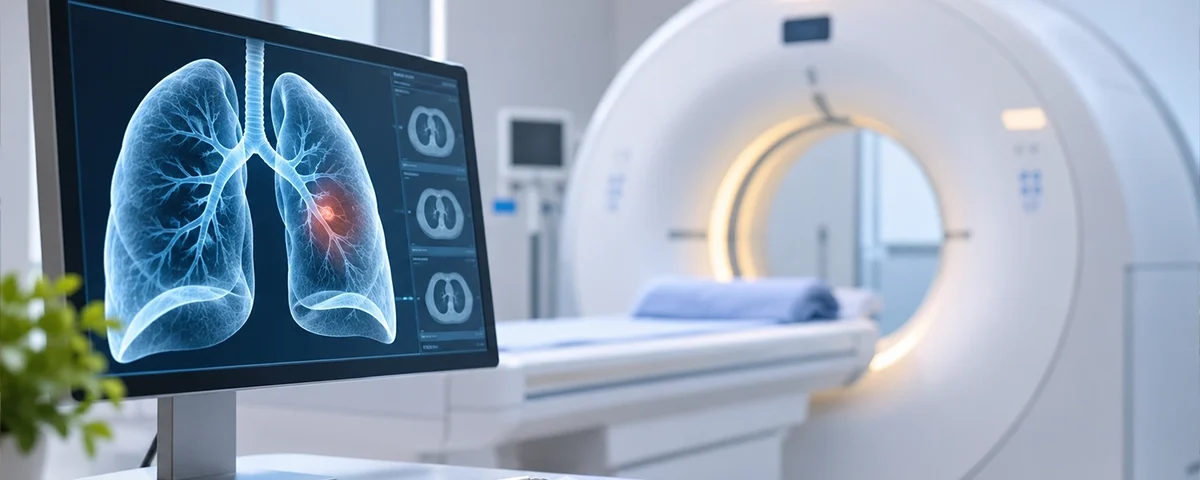
Instead of taking one flat photo, the CT scanner circles your body rapidly, capturing hundreds of razor-thin cross-sectional slices that build a detailed three-dimensional map of your breathing pathways. A radiologist scrolls through your lungs layer by layer, spotting abnormal nodules when they are barely the size of a single rice grain. Catching a nodule at that microscopic size gives doctors a genuine chance to remove it before it ever spreads into your bloodstream.
Who Actually Needs a Low-Dose CT scan?
Doctors do not recommend CT scans for everyone. Screening exists specifically for people whose lung tissue has accumulated heavy cellular damage over decades of breathing toxic combustion smoke or industrial dust.
Sit down with a doctor to discuss cancer screening in Bahrain if you meet these conditions:
- Age Fifty and Above: Most lung cancers occur in adults between fifty and eighty years old.
- Heavy Smoking History
- Current or Former Smokers
- Workplace Inhalation: You spent years working around asbestos insulation, silica dust, diesel exhaust, or industrial chemical vapors without wearing proper heavy-duty respirator masks on the job site.
- Family Medical History: A parent, sibling, or child was diagnosed with lung cancer, especially at an early age.
What Happens During LDCT for Lung Cancer Screening in Bahrain?
You do not need to fast beforehand or drink liquids before the scan. You walk into the radiology suite, lie flat on your back on a cushioned motorized table, and rest your arms comfortably above your head. The technician steps behind the protective glass partition and talks to you through an intercom.
The machine is an open ring. The table glides smoothly into the center, the technician asks you to hold your breath for five to eight seconds while the scanner spins silently. As it is a low-dose scan, it uses roughly ninety percent less radiation than a standard diagnostic chest CT, making it completely safe to repeat annually.
Advanced Oncology Treatment in Bahrain and Imaging at Al Salam Hospital
What matters just as much is having experienced doctors who know what to do if your scan shows a suspicious shadow or nodule.
Al Salam Specialist Hospital, a leading hospital for advanced oncology treatment in Bahrain, provides a complete diagnostic pathway under one roof.
Their specialized Smoker Screening Package and diagnostic services feature:
- Fast imaging that captures crisp lung slices in seconds without motion blur.
- Chest physicians, radiologists, and oncologists review your scans together rather than working in isolated offices.
- Interventional radiologists capable of sampling tiny lung nodules safely using real-time imaging guidance.
- If a nodule requires medical care, Al Salam’s oncology department delivers targeted therapies, modern chemotherapy, and dedicated supportive care without sending you abroad.
- Ground-level parking directly outside Building 1 makes getting in and out of appointments painless.
To book a screening consultation or speak with their imaging reception, contact AlSalam Specialist Hospital today
Frequently Asked Questions
Does a low-dose CT scan hurt?
No, not at all. You lie flat on an open table, hold your breath for six seconds, and the scanner takes the pictures without touching your body. There are no injections, dyes, or painful probes.
If the scan finds a lung nodule, does it mean I have cancer?
No, definitely not. Most lung nodules turn out to be completely harmless scars left behind by past chest infections, old bouts of pneumonia, or harmless dust inflammation. Your doctor will simply monitor the nodule with follow-up scans over six to twelve months to check whether it grows or stays completely stable.
Can I just get a regular chest X-ray instead?
No. Routine chest X-rays miss up to eighty percent of early-stage lung cancers because small nodules hide behind ribs, collarbones, and large blood vessels. Only low-dose CT scans have proven to reduce lung cancer deaths by catching tiny tumors before they spread.
Will private insurance in Bahrain cover lung screening?
Most private health insurers in Bahrain cover diagnostic CT scans when ordered by a doctor to investigate chronic coughs, shortness of breath, or high-risk profiles. Check directly with Al Salam’s insurance desk to confirm your direct-billing approval.